
Out goes one year; in comes the next. A steady temporal turnstile incessantly reminding us that while we may slow down, the astronomical structures dictating our cultural conception of time are rigid enough as to appear as a constant. In other words, my eyes need a rest.
In other other words, it is best-of-the-year time for all matters cultural discourse. There really is little value to it, this arbitrary comparison between pieces of media based on a calendar release date (usually region-specific, to make it all the less comprehensive). The numbers mean virtually nothing. The voices speaking are minuscule, as they beat the drum for individual and subjective tastes but under the guise of a universal acceptance that these here cultural objects are worth categorizing and hierarchizing into list-like structures for other people’s amusement (and, often, a confirmation of those other people’s own individual and subjective tastes).
In short, I am one iota of cultural detritus contributing to this “online discourse” problem, fueling factional groupthink under some self-prescribed claim to expertise. Or I just feel like recommending a few movies. You be the judge.
As is the case with every year, we get down to the final waning days and there are simply too many titles to catch up on. I spend most holiday seasons cramming in movies like I’m scrambling to prepare for a test I haven’t properly studied for. Nevertheless, I can’t see them all; some films always slip through the cracks and thus remain ineligible for inclusion on my list.
This year, some titles which could conceivably wind up making the grade but have heretofore gone unwatched: Armand, Babygirl, Bird, Blitz, The Brutalist, Exhibiting Forgiveness, Exhuma, Ghostlight, Good One, Green Border, Hard Truths, Inside the Yellow Cocoon Shell, Maria, The Order, The Outrun, The Seed of the Sacred Fig, Sing Sing, Union, Virmiglio, Wallace & Gromit: Vengeance Most Fowl, and a few dozen others.
Then there are the seen but not forgotten few that don’t rise to the arbitrary threshold I’ve made for myself. These honorable mentions are:
- All We Imagine as Light (Payal Kapadia)
- Anora (Sean Baker)
- Dahomey (Mati Diop)
- A Different Man (Aaron Schimberg)
- Dune: Part Two (Denis Villeneuve)
- Girls State (Jesse Moss, Amanda McBaine)
- His Three Daughters (Azazel Jacobs)
- I’m Still Here (Walter Salles)
- Kill (Nikhil Nagesh Bhat)
- Kinds of Kindness (Yorgos Lanthimos)
- Lost Soulz (Katherine Propper)
- Love Lies Bleeding (Rose Glass)
- Mads (David Moreau)
- Nosferatu (Robert Eggers)
- Problemista (Julio Torres)
- Rap World (Danny Scharar, Connor O’Malley)
- Rebel Ridge (Jeremy Saulnier)
- Small Things Like These (Tim Mielants)
- Turtles All the Way Down (Hannah Marks)
- The Wild Robot (Chris Sanders)
Here are my picks for the best 10 films of 2024.
10. Daughters (Natalie Rae, Angela Patton)

Netflix has a trio of documentaries currently shortlisted for the Academy Award. At least two of them are tear-jerkers. Will and Harper is crowd pleasing. The Remarkable Life of Ibelin is life-affirming. Daughters, directed by Natalie Rae and Angela Patton and centered around Patton’s program Camp Diva, is an emotional wrecking ball.
Without being overly didactic regarding prison abolition or the prison industrial complex, the film quietly displays the humanity inside systems that aim to render that humanity invisible to the outside world. Camp Diva’s initiative to host father-daughter dances in prisons could easily be depicted as a formula for emotional exploitation or as a socio-political lecture. However, by allowing the individuals involved, and especially the girls and young women living without their fathers at home, to express themselves openly and honestly, the reality of lived experience trumps any telegraphed message. People are people, and they deserve basic human rights.
9. No Other Land (Yuval Abraham, Basel Adra, Hamdan Ballal, Rachel Szor)

No Other Land is a deeply angering movie. The either-or way in which it has been embraced is an added frustration. At the Berlin Film Festival, where the documentary won an award, the German chancellor of culture choosily lauded the film’s Israeli co-director and not his Palestinian peer. The film has been short-listed for the Academy Award in the documentary feature category, yet it remains without U.S. distribution.
With an American context that often treats the ongoing conflict in Palestine in reductive shades of black and white, No Other Land presents the complicated reality that sees Palestinians slowly and systematically displaced and bullied into psychological submission by the IDF. Localized, human stories like the one captured in this doc are crucial to disabusing people of the notion that the conditions of the occupation in Palestine began in (and thus should only be considered through the lens of) the past year. Moreover, and importantly, it also foregrounds a basic fact of this conflict: that many who are directly impacted by what is going on are civilians, people who deserve empathy and basic human rights.
8. Soundtrack to a Coup d’Etat (Johan Grimonprez)

I am fascinated by those words which are over-used in discussions of cultural objects to the point of losing nearly all meaning. The circularity of my brain’s OS spins adjectives around, questioning whether they can be employed in such a way as to enliven them again. Often I conclude maybe not, and not least of which by me.
“Vital” is one of those words. As in, full of energy. But also as in, essential in pursuing the course. And also, necessary for life to sustain and to survive. Soundtrack to a Coup d’Etat is a “vital” history lesson that comes hard and fast, but it resonates with a contemporary urgency. The names, faces, and political and geographic shapes may change, but the situations of power across time share a haunting familiarity. With savvy use of a laundry list of sources and some occasionally didactic editing, Johan Grimonprez commits a séance.
7. Challengers (Luca Guadagnino)

Perhaps no movie this year better captured the idea of cinema as a sensory experience better than Luca Guadagnino’s Challengers. However you want to parse the central metaphor – sex is tennis, tennis is sex – and the extent to which you wish to criticize the metaphor for being fairly basic, the ability for Guadagnino, the cast, and writer Justin Kuritzkes to make a hefty meal out of the complicated threesome of relationships is noteworthy. Three of the year’s top performances, superb editing, and a series of tersely written scenes make the tennis match of a love triangle an exciting and sensuous experience. In the context of these laudable elements, even the film’s very silly final shot is electrifying.
6. Kneecap (Rich Peppiatt)

Kneecap is one of the most pleasant surprises of the year. You could compare its energy, favorably or unfavorably, to the likes of Trainspotting. But this is its own animal, deeply entrenched in a battle over language, heritage, and culture. It teems with life, distinctive personality, and raucous humor. Everything from the characters to the music to the subtitles has a pulse. After a year of many films that register as comatose by comparison, Kneecap is an adrenaline shot, or a line of coke (not ket).
5. Furiosa: A Mad Max Saga (George Miller)

Calling the follow-up to the critically acclaimed Mad Max: Fury Road a “Mad Max Saga” may come with the implication that this is a lesser, tenuously connected episode in the Mad Max franchise. In this sense, I think the title is inadequate. Not only has George Miller intentionally made his action franchise a loose canon with little care for continuity or serialization, but Furiosa continues Fury Road’s ambition to make an epic scale, mythology-tinged story out of a post-apocalyptic wasteland.
Aside from a different take on visual effects (more CG in Furiosa is a valid point of critique, although I think it plays into the lore-building subplot of the film quite well), Furiosa is as break-neck and adrenaline-fueled as its predecessor. To take the title a different way, the concept of the character of Furiosa being a “saga” implies something else, something that makes Furiosa one of the most interesting installments in the series. The film is about history, and more specifically historiography. How do we write our histories, and what conditions lead to history being written the way it is? This is the fundamental force driving the film, and it makes the film’s world more textured and engaging.
4. Do Not Expect Too Much from the End of the World (Radu Jude)

Do Not Expect Too Much from the End of the World is a far way off from slow cinema, yet it is still a long sit. It may initially seem impertinent that we are watching scene after scene of the protagonist criss-crossing through Bucharest in a car to fulfill her job of recruiting injured workers for a corporate safety video. Once the themes start locking into place, though, this rhythm takes on a new, gross quality. More importantly, once this rhythm is broken in the second part, the truly and brutally cynical nature of this beast of a picture comes into a striking and sublime relief. It is the darkest of dark comedy, but it is seriously funny on top of being a harsh takedown of callous corporations and corporatized media.
Also, Uwe Boll makes a cameo appearance. That alone justifies the price of admission.
3. Nickel Boys (RaMell Ross)

Cinema’s claim to bearing witness is long-standing. Film has long been a medium used to intimately place the spectator into different frames of reference and lived experiences. The perhaps over-cited but nevertheless eloquent Roger Ebert quote situates it quite succinctly: film is “a machine that generates empathy.”
I bring this up to illustrate how the experience of watching a film is fundamentally an experience of point of view. This could not be clearer than it is in RaMell Ross’s Nickel Boys. It is a film that is told almost entirely through the apparatus’s ability to simulate POV. The camera replicates the characters’ eyes; their gaze is our gaze. This alignment of gaze could be seen as a gimmick, but it is executed so confidently, and done with such a gorgeous sense of cinematography and editing, and carried through with some of the best performances of the year from its two leads (Ethan Herisse and Brandon Wilson), that I would never use the word “gimmick.” The corny film nerd buried deep inside of me wants to call it “kino.”
2. The Substance (Coralie Fargeat)
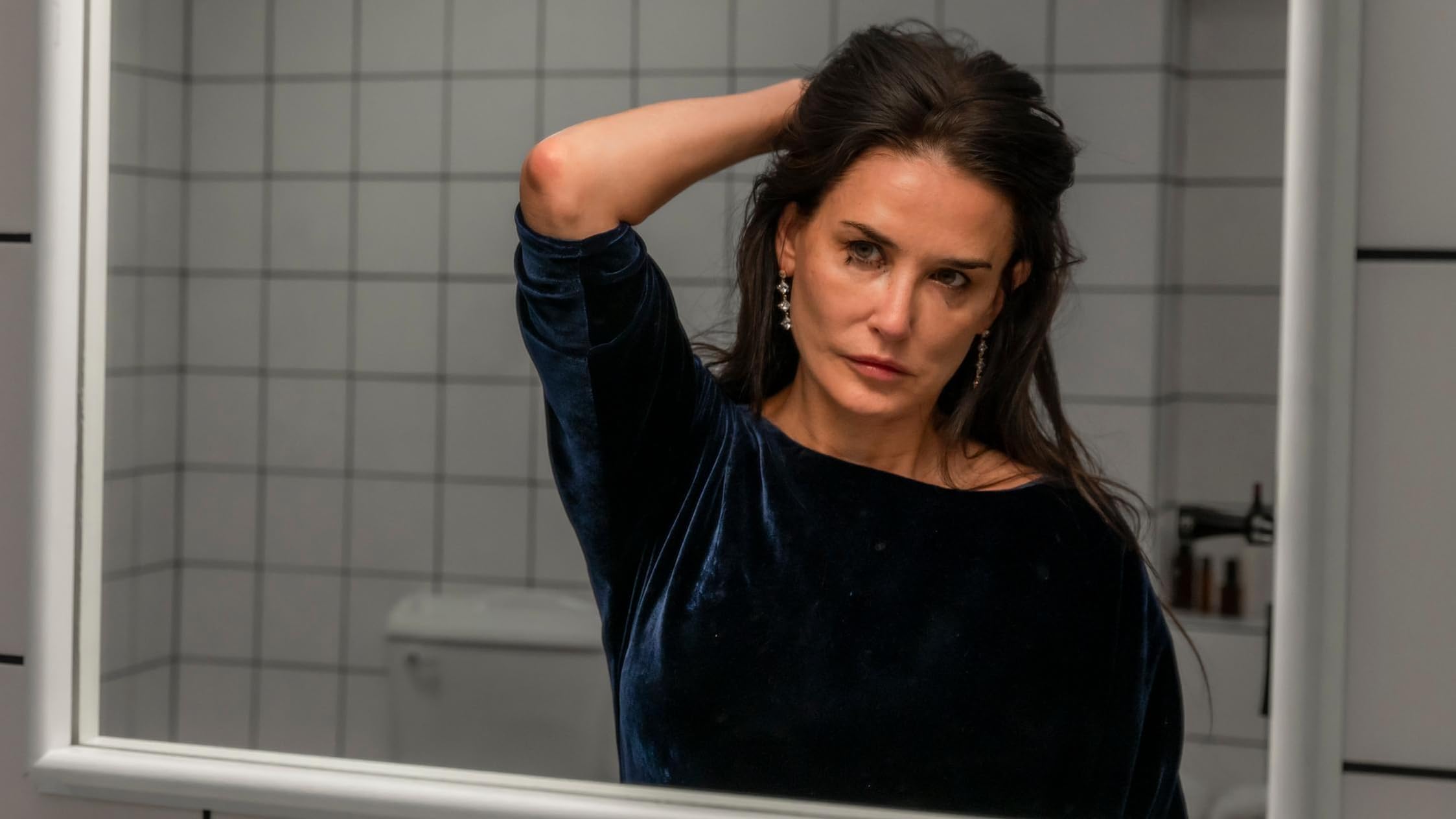
I’ve read many positive and negative reviews of Coralie Fargeat’s The Substance, and the divisiveness intrigues me. Many detractors call the film’s satire shallow, which is fair (others say the film is as hateful towards its protagonist as the characters in the film are, which is a take I completely fail to understand). However shallow it may ultimately be, I am enamored with how broad and brash this thing is. In fact, I think the broadness of its satire serves the film well. Plus, I fully admit a generic bias on my part. How can I deny a gaudy body horror film whose target audience is film festival juries and Oscar voters? Shove it down their throats!
1. I Saw the TV Glow (Jane Schoenbrun)

Jane Schoenbrun’s staggering, suffocating sophomore feature is huge. It taps into something familiar – feeling like a misfit in a hollowed-out suburbia – but depicts it in a singular, confident way. Rarely do I see films that converge the two major components of the medium (the “audio” and the “visual” of audiovisual) in such a seamless and all-encompassing manner. Top-to-bottom, each individual element of this film manages to resonate alone while also contributing to the overall core: they are arteries circulating life to and from the rich, beating heart at the center of this story. The sound design, soundtrack, dialogue, performances, editing, the imagistic glimpses at magical realism, the nostalgic pastiche – it’s all engrossing to the point of consuming you whole. This is rapidly becoming one of my favorite movies, period.
As always, thanks for reading!
—Alex Brannan (Letterboxd, Facebook)
 CineFiles Movie Reviews