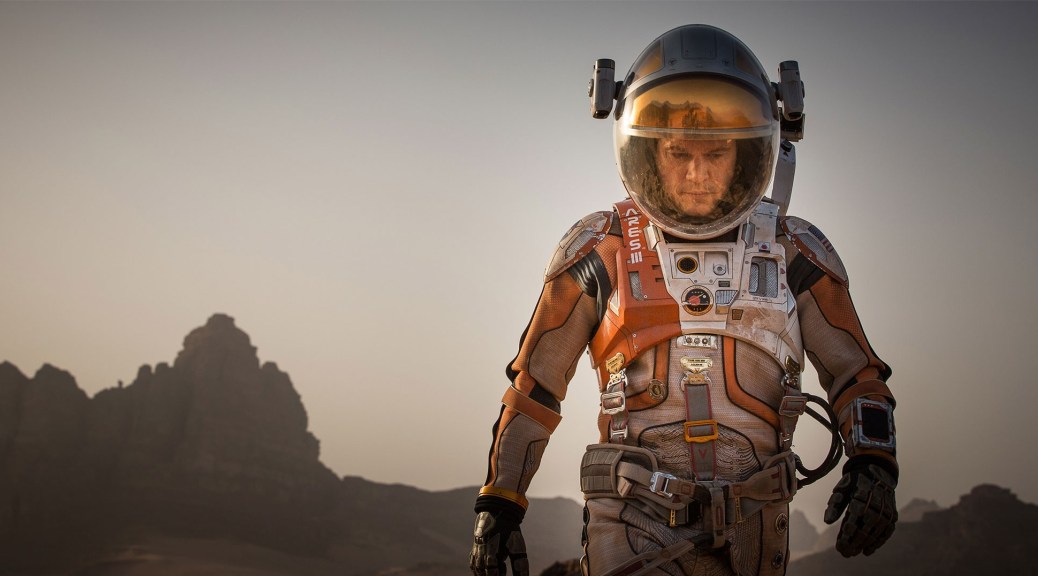
In The Martian, astronaut Mark Watney (Matt Damon) is abandoned and left for dead after a storm hits the surface of Mars, forcing the manned mission he is a part of to be scrubbed. On the way to the rocket, Watney is struck by a satellite dish that was blown off of their equipment, knocking him unconscious. As the rocket fires up into space, dwindling shots linger over Watney’s empty seat as the rest of the crew braces against the force of the ascent.

Then, we get an extended, wordless scene of Watney waking and staggering back to the HAB, the only oxygenated facility on the planet. The scene is entirely carried by Damon’s non-verbal acting. He pulls shrapnel out of a wound in his side, whispering pleas under his breath, just hoping that he will survive. It is a mesmerizing scene.
What follows is a long period of uninterrupted science. Damon stars in a one man show as he works to keep himself from starving to death. When we finally do cut away from Mars, we are flooded with a sea of actors working in the NASA environment. In comparison to Damon, the acting from the ensemble outside of Watney’s isolated world is understandably underwhelming.
That is because Damon owns this movie, and rightfully so. He embodies the optimistic-despite-impossible-odds Watney. Watching him does not become repetitive or boring, as it easily could in the hands of a lesser actor. There is lighthearted humor, psychological turmoil, and heart all over Damon’s sleeves throughout Watney’s lengthy time alone in space.
There are some standouts aside from Damon. Jeff Daniels plays the NASA director character of Teddy with his Newsroom-style dry wit and adversarial nature. There is little depth to his character (or any of the NASA characters, for that matter, save for perhaps Vincent Kapoor), but Daniels still pulls off a notable performance.
Speaking of Kapoor, Chiwetel Ejiofor has the best performance out of those characters who aren’t spinning around in space. His words are electric where other character’s words are simply there. The virtual interactions between Kapoor and Watney are profoundly well orchestrated by the actors, despite the fact the literal communication is all taking place on computer screens.
Other actors, such as Jessica Chastain and Michael Pena, turn in strong performances, but their screen time is limited. It is only toward the end of the film that we really get to see them work in the narrative, and by that point all eyes are on Damon.
The film suffers from some narrative cliches, particularly the use of “character strikes an epiphany as he/she speaks, then trails off mid-sentence.” This happens multiple times, where a character will be saying something alone the lines of “Well that would be impossible unless…” and then out of nowhere comes up with some crazy thing that moves the story along. It only serves to conveniently move the plot. It takes the viewer out of the experience, because that just doesn’t happen in real conversation.
The movie also suffers from the “dictate what you’re typing as you type it” style of virtual communication. Given the scope of this movie and the science being used for characters to communicate, this is the only way the viewer can get a cinematic taste of the conversation. In some spots they cover up the use of this cliche effectively, but most times it is painfully apparent. In a way, it takes the viewer out of the experience by making it obvious that the narrative is adapted from the written page.
In a similar vein, the use of visual representations during conversations relating to the science of what is about to happen is awkward most of the time. It is clearly another way for things to be explained more cinematically, but it is almost certainly the case that the characters in the film would understand the explanations without any of the visuals.
Despite its narrative shortcuts and cliches, The Martian is a worthy addition to the science-fiction genre. Director Ridley Scott handles the story well, focusing more on the character case study than the extravagance of the setting. It does service to the book in this way, although some translations of the scientific conversations to the screen are awkward. The climax is as gripping of a finale as one could hope for, showcasing the best cinematography of the film and the pinnacle of Damon’s outstanding performance.

The Post-Script
The Martian pleasantly surprised me. Thanks to the studious pen of Drew Goddard, we get as faithful an interpretation of the book as we could have hoped for. And Ridley Scott comes through with some visual spectacles, but doesn’t overdo it in a way that overshadows the protagonist. It’s definitely worth a watch.
The Martian is currently available to rent/buy on Amazon Video here

As always, thanks for reading!
Have you seen The Martian? If so, what did you think? Let me know in the comments!
–Alex Brannan (@TheAlexBrannan)
 CineFiles Movie Reviews