Animalia Paradoxa is screening as part of the 2024 Fantasia International Film Festival, which runs from July 18 to August 4.
I spent a good majority of Animalia Paradoxa trying to simultaneously parse the text and subtext of the film. The two must share some sort of relationship, I thought, yet mentally circling one made the other seem more obscured.

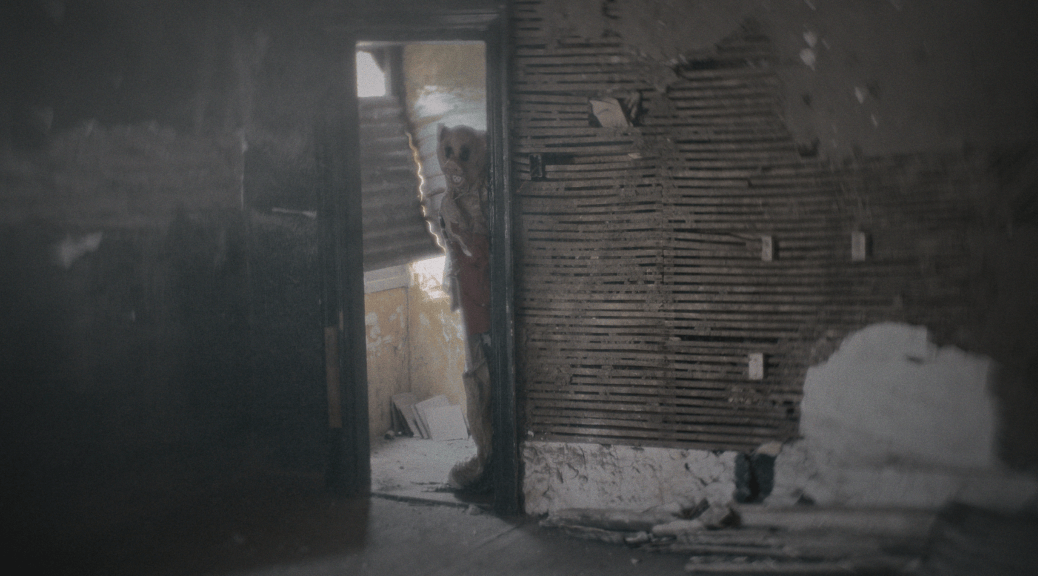
The text of the film involves, among other unexplainable practices that flirt with avant-garde, a post-apocalyptic world in which an organism in a gas mask trades goods for food which are then traded for moisture collected from another person’s hair, the resulting water then dumped into a large stationary tub that slowly, ever so slowly fills so that the masked protagonist may lie in it. This organism wishes to be a fish – is a fish, perhaps? This would certainly track, given the other creatures around them are masked to resemble animals. Fantasia’s liner notes for the film label the creature an “amphibious humanoid,” but the film itself does not care to articulate many specifics about its end times world.
The metaphor behind this slowly developing series of transactions must be ecological, I thought. This is a cycle of extraction and commodity exchange that mirrors what this world would have looked like in the pre-apocalypse. There is also a desire for the natural world that apparently has been ravaged to the point of death. “The ocean does not exist,” proclaims a cult-like figure who leads a band of destructive and homicidal zealots through the derelict tenement building in which the film is set. They proceed to destroy the bathtub. Then, the film cuts to footage of fire.
The polarities of destruction and conservation are seemingly at the core of the film, even as what the film wishes us to do with that polarity is not made immediately clear. What we do know is that, for the film’s mute protagonist, the sea is everything. It is the motivation for every action, every movement. The physicality of Andrea Gómez’s performance as the amphibian is, at its worst, unique and, at its best, entrancing. The film rebuffs the mainstream at many turns, but this challenge to convention begins and ends with Gómez’s striking performance.
The film’s director, Niles Atallah, co-founded Diluvio, a studio which is responsible for cutting edge Chilean visual art and cinema like La Casa Lobo (a fantastic and harrowing film worth seeking out). Animalia Paradoxa is similarly cutting edge. It is highly stylized, it mixes modes (a beautiful stop motion sequence graces the third act), and it relies on visual storytelling to capture something enigmatic and elegantly choreographed. In certain theatrical moments, it feels like silent cinema, yet it is also strikingly contemporary in its concerns and approach to genre. As some of the best films are, it is difficult to categorize. This elusiveness plays to the film’s strengths.
Animalia Paradoxa: B
As always, thanks for reading!
—Alex Brannan (Letterboxd, Facebook)
 CineFiles Movie Reviews