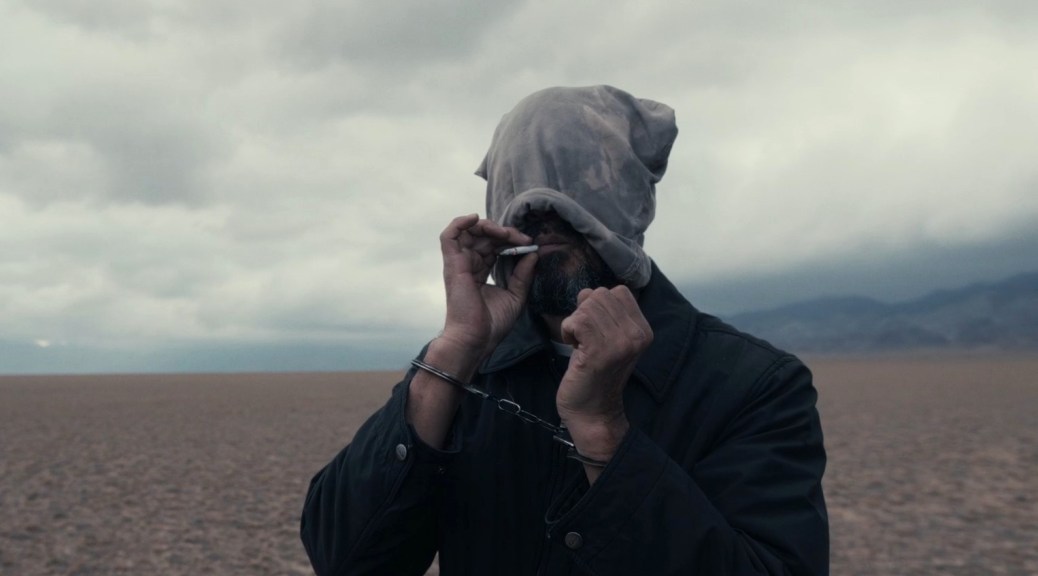
Steppenwolf is screening as part of Fantastic Fest 2024, which runs from September 19 to September 26.
Steppenwolf is a formally striking piece of grand existential absurdism. Within the confines of a brutal civil war, the characters in the film (in particular, the sociopathic Brajyuk) face death with an ironic distance that would make Camus’ Meursault proud.
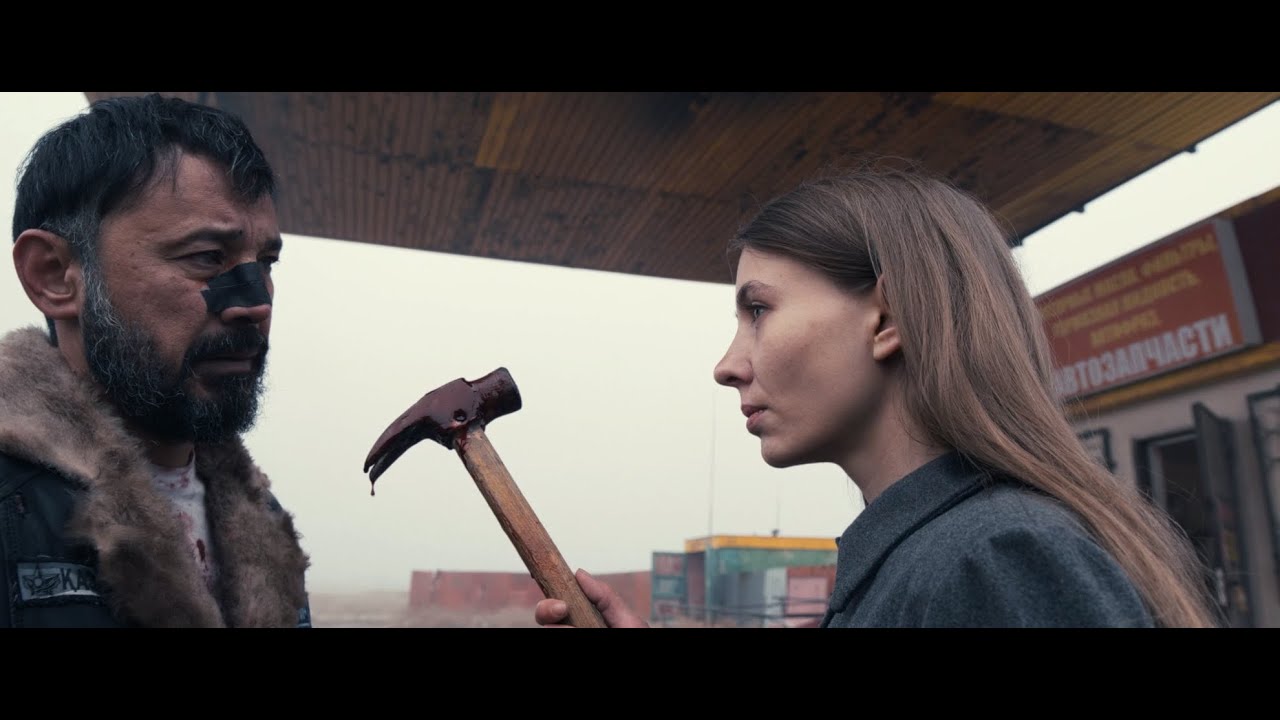
The film opens with the violent takeover of a remote police compound where political prisoners are being tortured. When staring down the barrel of a gun, Brajyuk (Berik Aitzhanov), a corrupt police interrogator, tells his rebel captors that the woman who has wondered into this site of violence in search of her son (Anna Starchenko) will pay $5,000 for his safe return. The gunman, having just concluded the merciless execution of two other police officers, responds with a laugh: “Alright, let’s help her. We’re all human.” This acerbic take on the relative consequence of human life and death fuels a tonally complex, yet ultimately unsatisfying film.
Director Adilkhan Yerzhanov’s film draws heavily on the American Western in the establishment of a bleak, inhospitable countryside populated primarily by madmen. Divorced from the often saccharine mythmaking of the American West, the same generic tropes are used toward bitter ends. This vision of the “Westerner,” that “man with no name” hero that roles into town, is actually a maniacally violent psychopath. What’s more, any hope of “taming” the turbulent wilderness is so far removed from this setting that any myths left to be made are written in blood.
Steppenwolf is, to its core, a bitter film. The comparisons being made to Mad Max, Tarantino, or the Coen brothers seem, to me, entirely misplaced. There is a visual corollary to No Country for Old Men, but if anything, that is a story whose author is Cormac McCarthy, a writer known for a similarly cynical and bleak vision of the Western wasteland. And as much as this is initially dressed up like a film whose intentions are to say something incisive about political (and extra-political) violence, in my eyes it can only possibly be effective when viewed as a deeply cynical vision of the absurd, wherein even the senseless actions of horrible individuals may somehow produce meaning, however inconsequential that meaning is in relation to the bloodshed required to get to it.
Still, this exercise is, at best, imperfect, and, at worst, inherently flawed. Tamara, the mother with speech difficulties in desperate search for her lost son, presents as an innocent in this entirely immoral landscape. But her innocence and relative passivity renders her character into a lesser foil to Brajyuk. She laughs at his rare moments of compassion, but also at the minor cruelties that he subjects her to. And her central, driving motivation is itself something of a MacGuffin, not building toward anything meaningful but simply there as the reason for the plot to continue on through its violent paces.
As beautiful as the thing is, Steppenwolf struggles mightily to contend with its nihilistic tendencies, tendencies which definitely do not require such extremity in order to satisfy the finer points of its existential preoccupations. Yes, the indifference to life is a feature of the film, as opposed to a bug, but the overbearing weight of Brajyuk’s brutality makes the film’s final turn, initiated by Tamara speaking to the necessity of goodness, an impossible one. As we see in the end, the film is aware of this very impossibility (hence the absurdism), but the question we are left with as a result of this conclusion is: What was the point of this grim exercise?
Steppenwolf: C
As always, thanks for reading!
—Alex Brannan (Letterboxd, Facebook)
 CineFiles Movie Reviews