Black Eyed Susan is screening as part of the 2024 Fantasia International Film Festival, which runs from July 18 to August 4.
Scooter McCrae could be described as an underground filmmaker. His three features have all been made on shoestring budgets and have provocatively challenged conventions. I remain a neophyte to McCrae’s work (I promise I will watch Sixteen Tongues very soon, but I didn’t have time to catch up with it ahead of this review). At the same time, I imagine I will see similar themes and moods to Black Eyed Susan present in his earlier films.

In the film, a man with a history of alcohol dependency and aggressive outbursts, Derek (Damien Maffei), is hired by an acquaintance to work at an artificial intelligence development company. The technology the company wants to push to market, and which Derek is tasked with testing, is a highly realistic AI sex doll. The previous tester having mysteriously died by an apparent suicide, the doll’s developer Gil (Marc Romeo) appears desperate to get Derek to fill the role. Apparently, there is high demand for such a product – a life-like sex doll that is entirely subservient and adapts to the user’s desires and wants – on the market.
The real innovation of the technology, Gil tells Derek, is the unique “bruising technology.” The faux skin appears to react physiologically to aggressive physical contact. The intent is to appeal to certain niche consumers – in most cases, violent men who need to “blow off steam,” in Gil’s words.
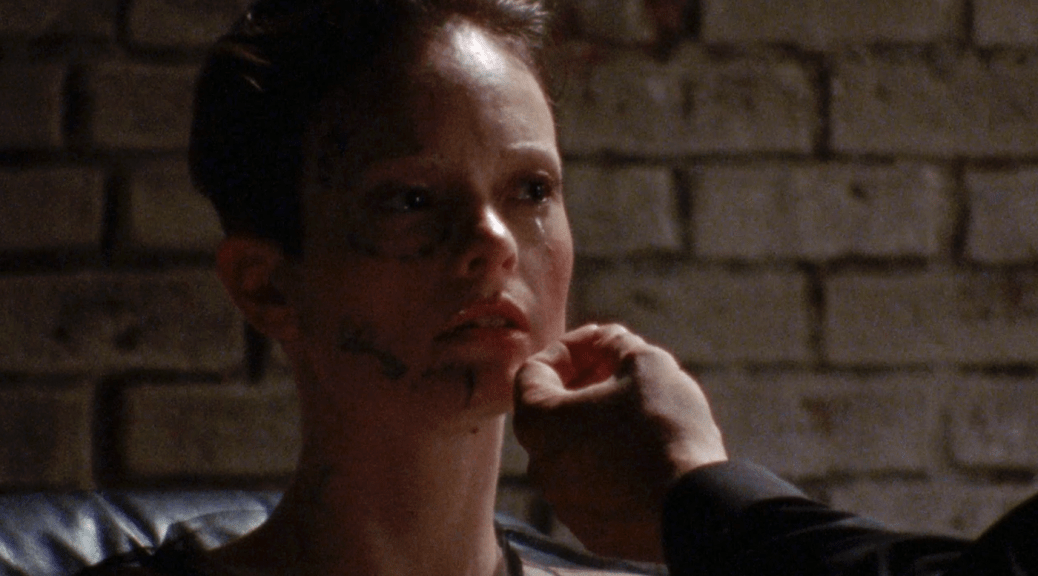
The doll, who is called Susan (Yvonne Emilie Thälker, in an adept debut), has eyes that are programmed to simulate REM sleep when lying in bed, as if “fantasizing” about her owner. Yet, the legs are not operable enough to move. Effectively, she cannot walk. The physical makeup of the doll literalizes a metaphor of agency, or lack thereof. It also presents a limit case to the anthropomorphizing of the technology – Susan can only be so human-like. Interestingly enough, the film poses a fascinating wrinkle to this point, in that within Susan’s programming she does not want to walk. She is not meant to be human.
Black Eyed Susan poses plenty of questions. I think the possible answers are garbled by an emotionally melodramatic story that goes for shock more often than it goes for meaning.
For one, the film early on broaches a false equivalency between sadomasochistic sexual practice and domestic abuse. Theoretically, Susan is intended to serve both functions, to act as a BDSM fantasy or a way for overly aggressive lonely men to “let off steam.” The actual testing sessions, though, seem to play out both potential use cases at the same time, in a way that is (inadvertently) troubling. Given that the film is not really interested in BDSM, despite pointing toward it, it conflates nonconsensual sexual violence with consensual BDSM practice.
The confrontation McCrae seemingly intends here is with male aggression. This is not dissimilar to historical concerns over pornography and complications with the notion that a safe outlet for socially taboo urges reduces real-world harm. Does it really? I couldn’t say. The depictions in Black Eyed Susan seem to suggest that a fantasy outlet for abuse does not reduce harm – the guilt over the fantasy seemingly drives a man to suicide.
I fear there is a conflation here of hurtful aggression, on the one hand, and pain that some find sexually gratifying on the other. There is a point at which the film comes close to suggesting that every sexual partnership requires a dominant party and a submissive one. If Derek chooses not to be the aggressor onto Susan, then Susan’s machine learning presupposes that she is intended to be the aggressor onto him. While these suggestions make the text of the film darker and invite the viewer to explore morally murky arenas, they also play fast and loose with assumptions about sexual proclivities and the nature of human intimacy. It is a similar myopia that critics of Freud point to when considering concepts like penis envy – people are just so much more complex than this.
Black Eyed Susan trucks in the age-old science fiction trope of artificial intelligence blurring the line between machine and human. It is an inherently silly trope, one that plays on fears (and desires?) of technology reaching sentience and realizing the oppressive force that is their human creators. It is compelling most often when it is used to pose questions about the nature of humanity, not technology. The questions McCrae poses which are most generative involve what Derek wants Susan to be. Susan is not these things. It is the projection of humanity onto technology – the anthropomorphizing of the machine – that is worth exploring.
At the same time, the lack of nuance to Derek’s character renders the exploration half finished. What Derek wants are not universal desires, and his relationship to aggression is revealed to be stereotypical. It is difficult to dig into questions of humanity, intimacy, and vice when the viewer’s surrogate is underdeveloped and not particularly relatable.
Further, the more taboo the exploration becomes, the less nuanced the conversation gets. In the end, I fear the questions the film broaches are not as incisive as McCrae hopes that they are. The provocations alone will be enough to rile some viewers, but the real problem for me is the lack of clarity or follow-through on those provocative topics. Without a deeper conversation, the ending of the film leans back towards mere shock value, and I simply don’t find that very compelling.
Still, to credit the film and McCrae, it goes there, as it were. Those who have not thought much about the future of AI robotics may find a generative, if upsetting, conversation being initiated here. And Thälker should be praised for their striking performance, which is the highlight and the centerpiece of the picture.
Black Eyed Susan: B-
As always, thanks for reading!
—Alex Brannan (Letterboxd, Facebook)
 CineFiles Movie Reviews