Queens of Drama is screening as part of Fantastic Fest 2024, which runs from September 19 to September 26.
Alexis Langlois’s Queens of Drama is a riff on the A Star is Born formula, wherein the young, bright-eyed ingenue is thrust into a world of celebrity that bends and breaks them. The young star-to-be in question is Mimi Madamour (Louiza Aura), a quiet 18-year-old auditioning for an American Idol-adjacent singing competition. While there, she meets Billie Kohler (Gio Ventura), another competing hopeful. In some ways, their drastically different experiences with the singing audition paves the way for their diverging paths toward pop notoriety.
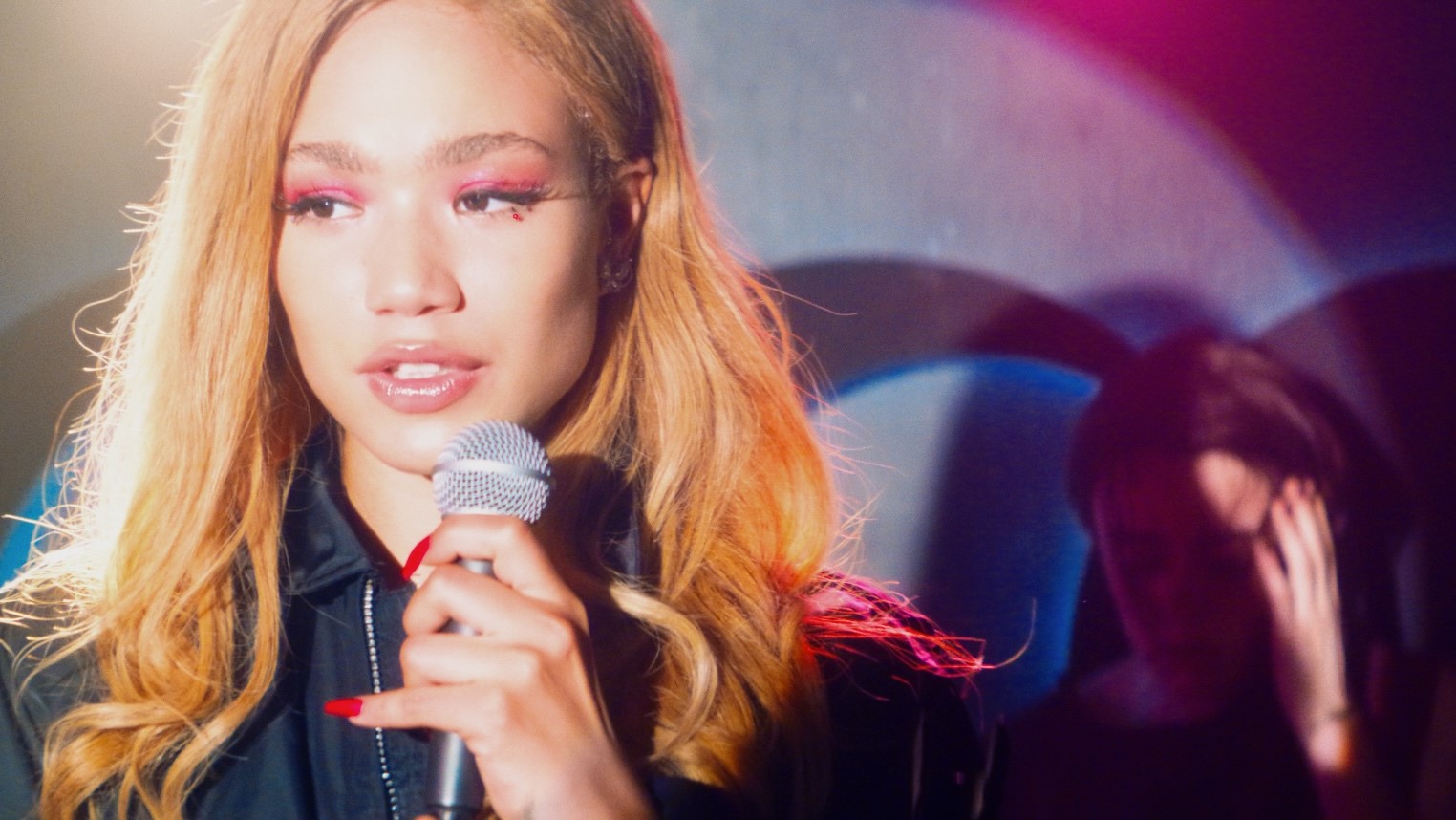
The film quickly establishes a dichotomy between the American Idol-ization of mainstream pop and a much more sonically potent underground music scene. In both cases, basic appeals to anti-patriarchy pervade. Billie blames her failed audition to the show’s reification of patriarchy, to which the judge replies, “patriarchy does not exist.” Later, Billie sings to the crowd of a lesbian bar, “you and me will fuck…the patriarchy.” Billie’s punk act, Slit, will later find pop prominence, demonstrating a contradiction of mainstream culture’s ability to both suppress and co-opt.
As it progresses, the film critiques this trend of pop feminism through equal measures of earnestness and camp irony. Mimi traverses through an initially bright, almost fantasy version of 2005 with a pure-of-heart intention that clashes (nicely) with the highly stylized world. This earnestness gets lost in the whirlwind of her romance with Billie and her love affair with stardom (and this shift arguably happens too quickly for us to get a full sense of her character).
The show in which Mimi competes and which ultimately anoints her with fame, fittingly called Starlets Factory, contains the central contradiction at the heart of the film’s critique. The same show that props up ingenue divas destined to be role models for millions also denies the possibility of feminism within its industrialized structure that churns out images of empowered women through a cutthroat and often demeaning competition. It has been some time since American Idol maintained culture relevance, but one can probably think back to how cruel that show was to contestants, not just on the basis of their singing ability but also on their appearance and potential fit within the show’s narrow schema of what values a “pop idol” ought to embody.
Starlets Factory is depicted in an adequately ghastly light, with over-saturation and side-eyeing extras making this world of aspirant fame feel sickly sweet and overtly nasty. In one nicely done sequence (with an obvious visual metaphor), a barrage of onlooking fans froth at the mouth toward Mimi as Billie is blocked from reaching her on-stage.
The “star is born” narrative is nothing new, but the poisonous way it is shown here is striking, particularly when it comes to dream-like sequences, depictions of period-accurate internet culture (an allusion to “Leave Britney Alone” in a movie was not on my bingo card for 2024), and, in one gloriously dizzying sequence, a drag rendition of the two protagonists’ hit songs. The film does also revise the (overdone) A Star is Born plot-line in a few important ways. Namely, it does not provide Billie with the benefit of stardom from the outset. Billie is known only within the circle that makes sense for that type of music at that time; it is only later that this music is granted entry into the mainstream.
A few other notes: The two performances at the center of this, from relative unknowns Aura and Ventura, are both very good. And the original songs made for the film all do their job in enhancing the period-specific sonic landscapes on display.
I still have a few Fantastic Films to catch up on this week, but as of now, this may be my best of the fest.
Queens of Drama: B+
As always, thanks for reading!
—Alex Brannan (Letterboxd, Facebook)
 CineFiles Movie Reviews