
No matter how you want to trace the lineage of the music biopic, we don’t arrive at a formula-to-an-absolute-fault film like Bohemian Rhapsody without first traveling through James Mangold’s Walk the Line. To see Johnny Cash resurface in Mangold’s return to the genre (now played by a perpetually suave Boyd Holbrook) is like witnessing a poltergeist haunting another film. Or a demon that somehow escaped total exorcism from Walk Hard: The Dewey Cox Story, a superior take down of the music biopic and a film that remains culturally relevant so long as Hollywood continues churning out mediocre celebrations of celebrity.
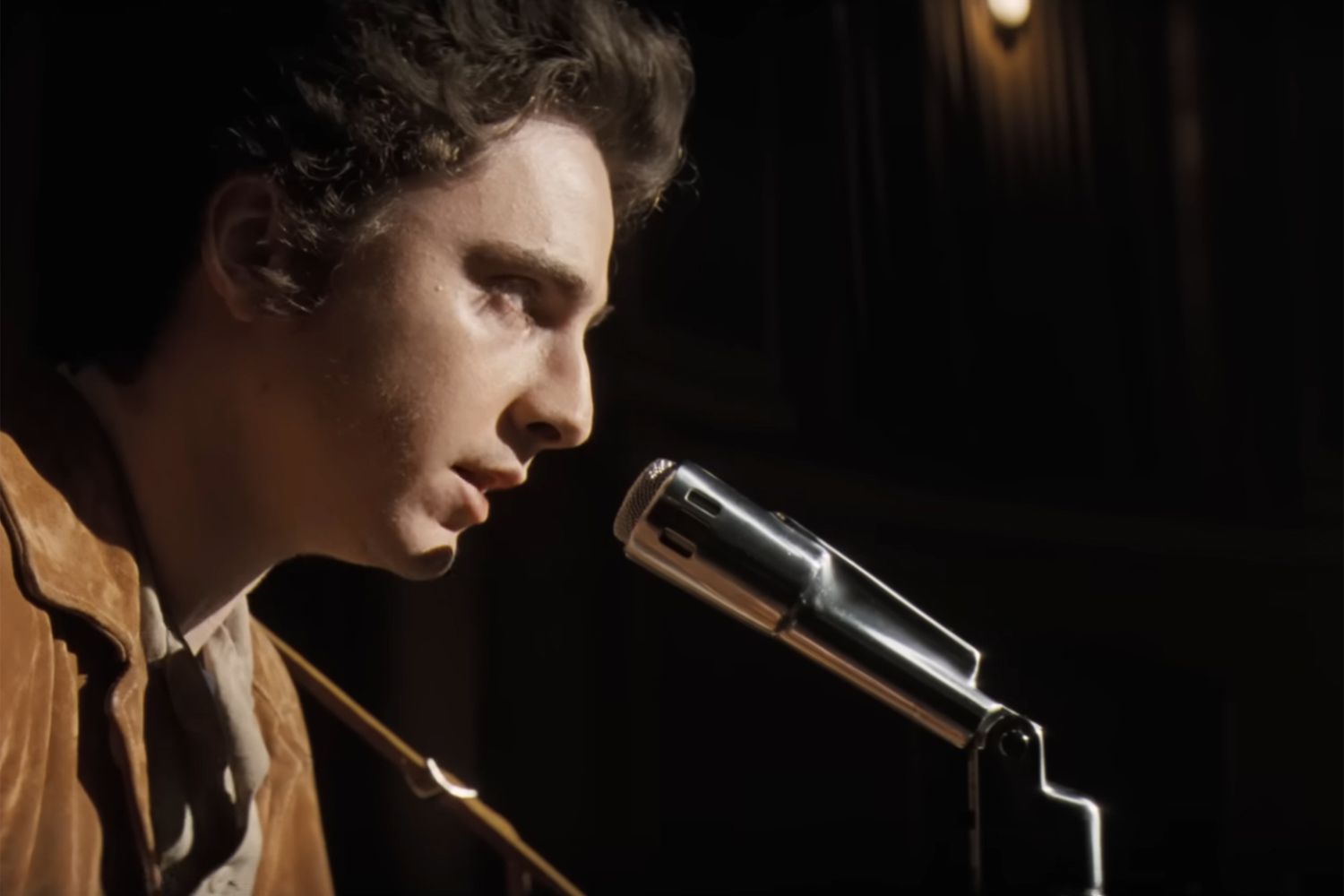
Walk the Line was a crossover success, breaking $100 million at the box office, garnering generally positive reviews, and earning a number of accolades including an Oscar for Reese Witherspoon. A Complete Unknown is angling to do the same. The problem (perhaps) is that between then and now we have almost 20 years of soulless movies that attempt to get to the heart of what makes an “artistic genius.” This didn’t stop Bohemian Rhapsody from scooping up a smattering of awards, including an Oscar for Rami Malek’s lip syncing. Timothée Chalamet at least has him beat on that front.
So maybe there is no problem after all. There’s nothing wrong with Hollywood having some harmless fun, dressing up famous folks as other famous folks. All’s well in love and a bit of light entertainment. And Mangold’s Bob Dylan film A Complete Unknown is certainly entertaining, if only in fits and starts. Chalamet’s iteration of a Bob Dylan lookalike is fairly savvy, especially when he sings. The impression is impressive, even if proper characterization is a hopeless endeavor.
A Complete Unknown is obsessed with the magnetism of Dylan. It hangs on the reaction shots of onlookers every time he is on stage. Even as the crowd boos his electric turn, Mangold takes pains to show the longing every audience member has for the ideal Bobby Dylan. This includes Elle Fanning’s Sylvie, who not once but twice is subjected to the camera’s gaze as she breaks into tears at the realization – a realization the character comes to through Dylan’s lyrics – that her relationship with Dylan is an impossibility and a foregone conclusion. Fanning’s role is utterly thankless; the extras in Dylan’s crowds wide-eye gawking at the folk singer’s greatness get more to do.
Ultimately, the script doesn’t quite know what to do with the enigma of Dylan. It grounds him adequately through the lens of his loose understanding of monogamy. But the narrative loses him somewhere between the turbulent relationships and the sleepless brain constantly tapped into some greater literary purpose. Much of the Dylan musical genius is represented by him mumbling through song lyrics in the middle of the night, juxtaposed by those songs painting the walls of the picture from corner to corner. At a certain point, reciting songs isn’t providing new insight: it’s just playing the hits.
This compilation album of covers is perfectly fine for a time, during the stretch when the film walks through the familiar paces of the biopic. Dylan rises, alienates himself from former friends, changes his style, and reaches the precipice of becoming something culturally transcendent. As the script gets closer to the shoe dropping, though, the more that the broad-strokes narrative struggles to maintain clarity over its subject. The final Newport Folk Festival sequences, and the scenes leading up to it, are shoddily handled. Every beat is foreshadowed much too hard and much too far in advance, especially considering anyone coming into a Dylan biopic will already have a good idea in their head of what the “Dylan goes electric” scene will look like.
Instead of pulling the narrative together into the pat conclusion the film is going for, the final scenes are heavy-handed and rushed. In the end, what is it that we get from this dramatized depiction of Bob Dylan? Clarity is likely not a reasonable goal, yet the film moves neatly through a three-act structure like all those other biopics. Impersonation seems to be the best case scenario, and if impersonation is the goal, I suppose A Complete Unknown passes with honors.
To be fair, the idea of using the biopic formula to capture what is inscrutable about an artist may be a fool’s errand to begin with. Nevertheless, A Complete Unknown tries, but it really only gets as far as: “Bob Dylan sits pensively in a chair while everyone else celebrates his achievements.” It just doesn’t feel like a fulfilling resolution. Given Todd Haynes already skillfully deconstructed the enigma of celebrity in his kaleidoscopic Dylan film I’m Not There, A Complete Unknown looks all the more boilerplate and skin-deep by comparison.
Still, the music works to the crowd and the performances are, in the main, very good. Monica Barbaro is striking and ear-catching as Joan Baez, a fiery foil to Dylan that the film could use more of. And Scoot McNairy makes a surprisingly rich performance out of a mute, bed-ridden Woody Guthrie.
A Complete Unknown: C+
As always, thanks for reading!
—Alex Brannan (Letterboxd, Facebook)
 CineFiles Movie Reviews