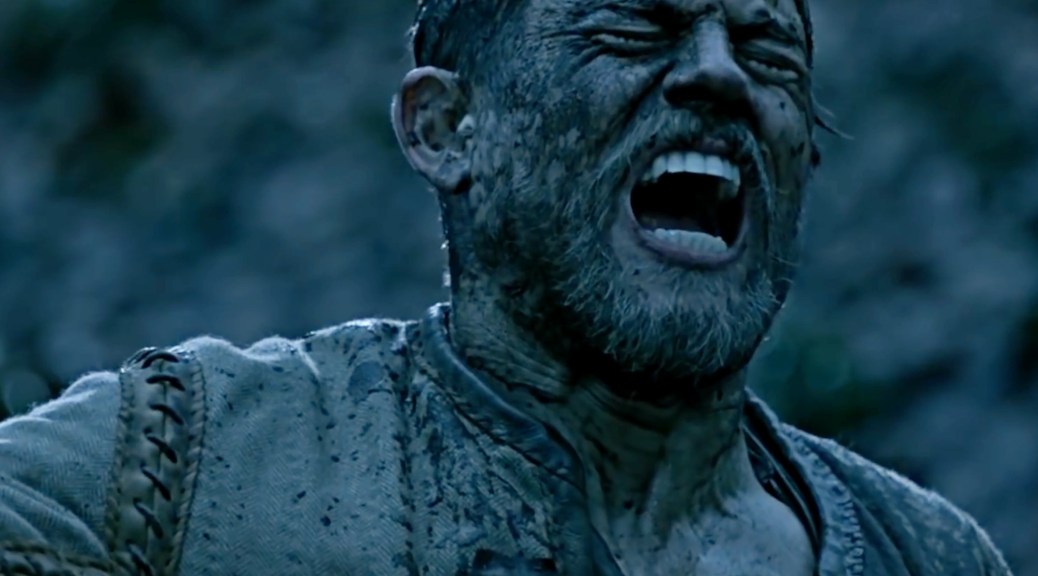
Director Guy Ritchie’s new venture, King Arthur: Legend of the Sword, opens on a war sequence that introduces Uther Pendragon (Eric Bana), the father of the once and future king Arthur (Charlie Hunnam), as well as one-time king Vortigern (Jude Law).
It is a scene marked by blurry action and messy narrative introduction. Luckily, it is also a scene that is returned to multiple times over throughout the film.

Following this, we watch little Arthur grow up before our eyes in a very Guy Ritchie-style expository montage. His entire youth is summed up by him becoming gritty with a chip on his shoulder. And fighting. Lots and lots of fighting.
You can see the pattern. The film races by at a clip that brushes over important moments of character building. Story beats pass by too fast for anything to feel relevant or for the setting to feel adequately lived in. Still, the film manages to slow down for exposition dumps and redundant flashbacks. The pacing of the film, thus, is inverted from what is expected.
The film makes it clear that there are few things you need to know. Vortigern is a fascist ruler with a black heart. We don’t know why, nor are we asked to care why. I mean, we are given backstory as to why, but that isn’t character construction.
Arthur is the big-heartedest pimp in the kingdom. He is pure of heart not by character, but by audience preconception. But, again, we are not asked to care about this. We already are expected to know the King Arthur tale, so the movie brushes past giving Arthur a personality beyond the archetypal Ritchie dry wit.
So plot is favored over character: so what? An audience won’t care. This is a Guy Ritchie medieval action flick. They’re not here for depth!
Sure, there is action. Largely, it is captured well, save for some shakiness, some blurriness, and a lot of rapid pans and zooms. Frenetic and energetic as it is, the stakes of the moments are not always evident. Few goals become complicated in the known arc of the story—that Arthur will ascend to the throne that is rightfully his. The pressure and adversity of challenge is replaced by a sort of smugness in stylization.
While this works in Ritchie’s more tongue-in-cheek pictures, here it seems out of place. The film does benefit some from that Ritchie energy. His brand of sardonic humor adds levity to a too-often droll genre.
This just isn’t enough. Witty and humorous as it is, with one or two set pieces worth attending the eyes to, King Arthur: Legend of the Sword suffers from its stylized pacing issues and uninspired use of source material.
King Arthur: Legend of the Sword: C
As always, thanks for reading!
Like CineFiles on Facebook for updates on new articles and reviews.
—Alex Brannan (@TheAlexBrannan)
 CineFiles Movie Reviews