
Sometimes I Think About Dying and Hippo are screening as part of the Fantasia International Film Festival, which runs from July 20 to August 9.
Sometimes I Think About Dying
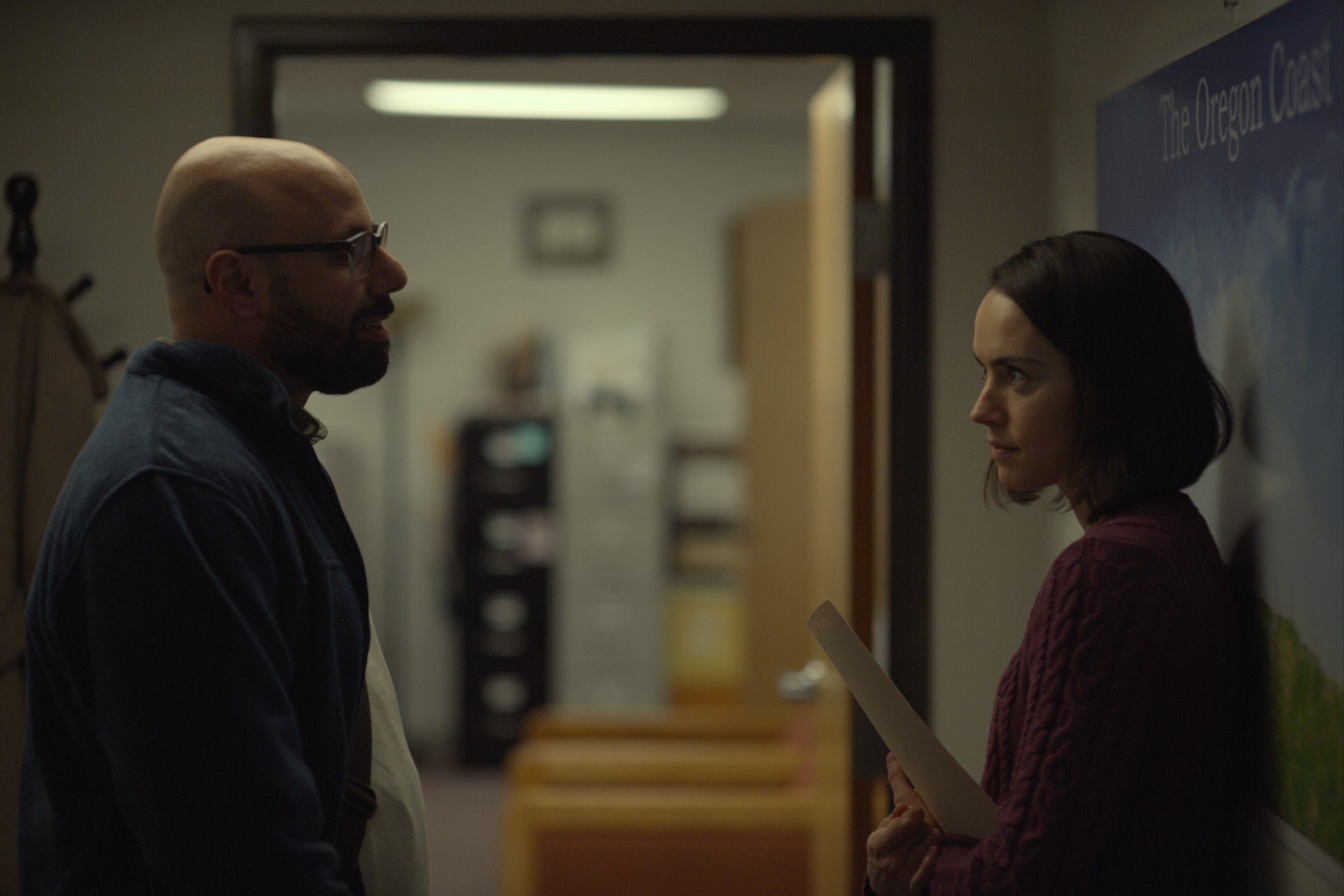
Fran (Daisy Ridley) leaves her office job each day, microwaves herself a dinner, and sits alone on her couch. Occasionally, during these quiet moments, she does what the film’s title suggests, roving through fantasies of death in her mind. Then she returns to her life the next day, sitting solitary at her desk and observing as her co-workers mill about the small office chatting each other up. She takes in bits and pieces of banal conversations but never participates herself. She just sits and chews at the ends of her fingernails, at a careful remove from those around her.
The title and description of Rachel Lambert’s Sometimes I Think About Dying suggests a dour film about depression, and at first it appears like this will be a clinical character study about mental health. We spend a long stretch of act one sitting with Fran, who is going through the paces as if waiting for life to happen to her. At the same time, Fran is not a character that is static or passive, even as she presents as both in the physical world. And Lambert adds light touches of humor in the idle chatter that juxtapose nicely with Fran’s inner thoughts, indicating how Fran, for all we know, is the most interesting and vibrant person in this office.
When Fran does act in a way that pushes beyond her usual arms-length social boundary, this is also depicted as a comedic beat in which the butt of the joke is social banality. The film taps as much into this comedy as it does into its darker themes, resulting in an experience that is robust relative to the paltry plot. Ultimately, though, the success of Sometimes I Think About Dying relies on the degree to which one can identify with Fran, whose remove from the world around her ranges from painfully relatable to utterly alien. Ridley, to her credit, manages to add personality and nuance to both ends of this spectrum.
Sometimes I Think About Dying: B
Hippo

Hippo is an offbeat comedy; perhaps too offbeat for its own good. If initial online reactions are to be believed, the audience at the premiere of Mark H. Rapaport’s debut feature (which is executive produced in part by Danny McBride and David Gordon Green) were in large measure dialed into what this film was doing comedically. I, for what it’s worth, watched the film from the quiet comfort of my own couch, so I had nothing to gauge the humor of the film against save for my own snooty tastes regarding comedy.
The film could be compared, favorably or unfavorably, to Yorgos Lanthimos’ Dogtooth. In both, young people live out their days in isolation inside an unassuming home. They have perceptions about the world beyond that are at times naïve or entirely inaccurate. Psychologically, Hippo (Kimball Farley) and Buttercup (Lilla Kizlinger) are immature for their age but nevertheless trying to figure out what it means to be a human adult. They are siblings, though the voiceover narration (provided by Eric Roberts) tells us almost immediately that they are not related by blood (this will be important later). They both find themselves, for different reasons, fascinated by the idea of sex, and this fascination pulls the plot of the film in wild directions as the two explore their desires.
People will likely be quick to attribute the rampant sexuality and quirkiness of this script to Freudian concepts or to Lacan’s mirror stage (in one particular scene, at least). But what the film has to say about sex, to my eyes, reads fairly thin. The characters experience arrested adolescence and fixations which could map onto Freudian stages of development, but the script’s preoccupations are too scattered to say much about what it all means. Hormonal though it is, the comedy renders the psychoanalytic, at best, farcical. Meanwhile, the characters, quirky though they are, deliver deadpan punchlines with a tonal energy that grows tiresome the longer the film continues.
Hippo: C+
As always, thanks for reading!
—Alex Brannan (Twitter, Letterboxd, Facebook)
 CineFiles Movie Reviews