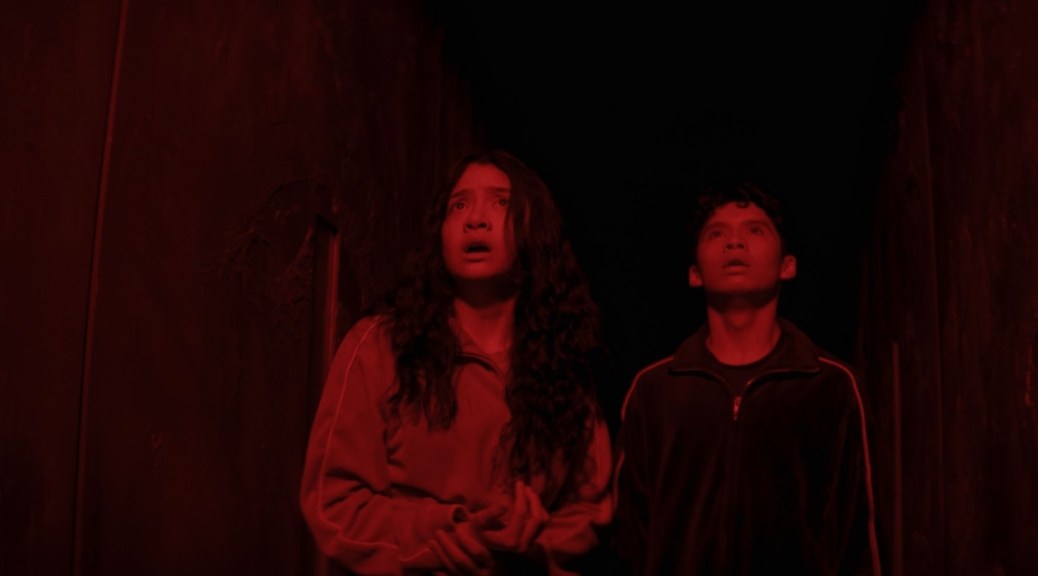
Home Bodies is screening as part of the 2026 Fantasia International Film Festival.
In Home Bodies, directed by Casey Walker from a script by Marcus Sullivan and Adrian Murray, two children live alone in a small, two-story home that simply doesn’t look right. Dark, cavernous hallways have an industrial quality to their architecture. The appliances in the kitchen, or “food room,” as the kids call it, are out-dated, yet they produce hot food instantly. The children watch VHS tapes that re-run episodes of a single, low-budget children’s television show set on a farm. If things don’t read as peculiar by this point, the children speaking to a disembodied voice anthropomorphized in the form of a pulsing white light, a voice they refer to as “Father,” leaves no room for debate. These siblings are being held hostage in some sort of psychological experiment.
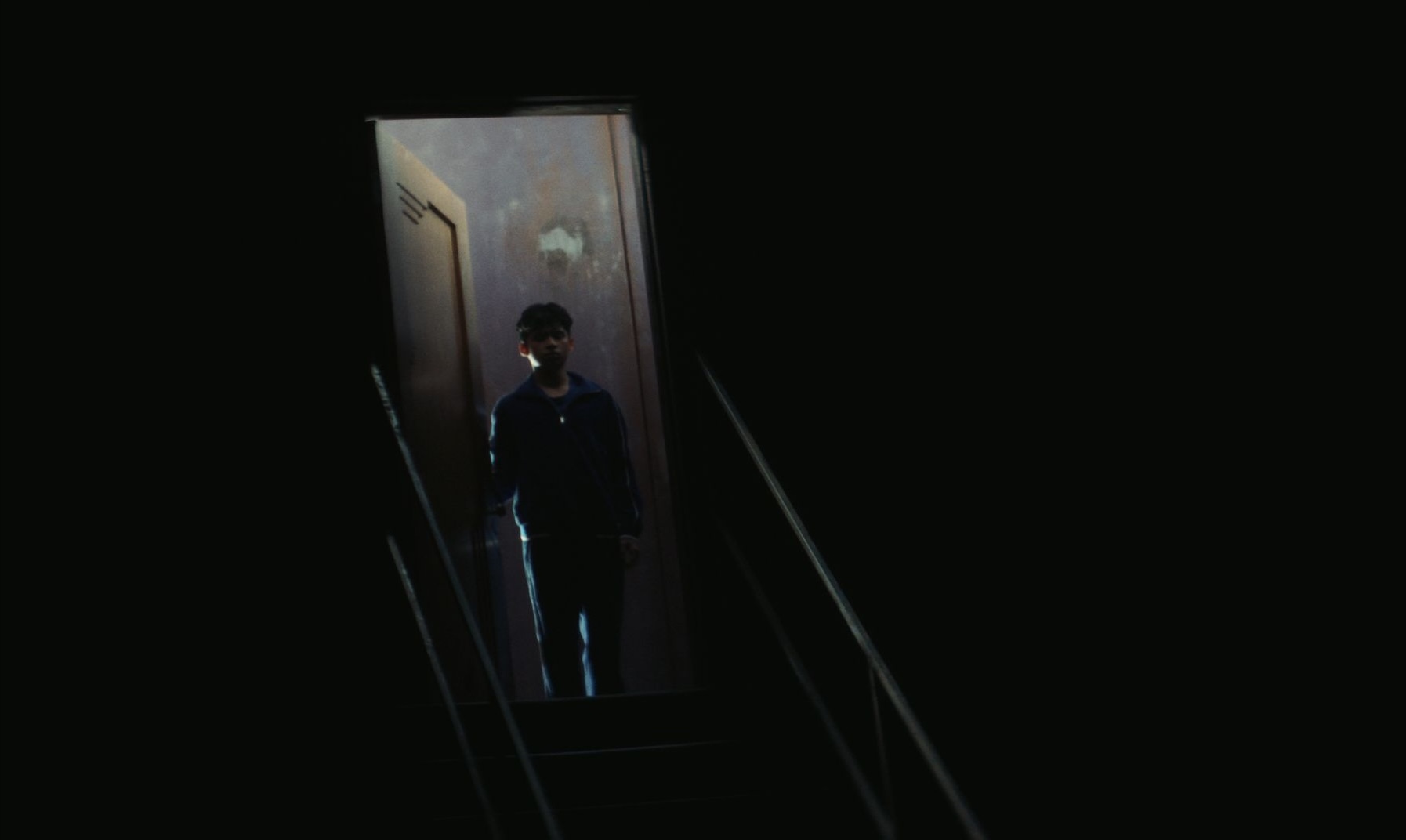
On premise, Home Bodies is very Twilight Zone slash Black Mirror adjacent. It has one central, fantastical sci-fi concept that it rides for 95 minutes. The answers to its questions aren’t perfectly satisfying (and, in fact, I find the ending to be the biggest fumble of the entire thing), but the experience of watching two children navigate the horrific trials is the interesting part.
These children are known simply as Red and Blue (played by real-life siblings Emma and Ian Ho). Blue is more than happy continuing on with their day-to-day, eating instant oatmeal and drinking glasses of “milky” while watching the “pig episode” of the farm show for the umpteenth time.
Red, meanwhile, is bored. The repetitive nature of their existence is clearly getting to her. But Blue also realizes the consequences of not maintaining the status quo. Blue has been punished by Father before, so he is very careful to keep Father in his and Red’s good graces. Unfortunately for them both, Father is ready to disrupt the status quo himself. One day, the siblings are provided a “gift” in the form of an androgynous, bald, mute humanoid thing (is it a human? is it a toy? the children are not sure). This “Pal” (Ess Hödlmoser) is disconcerting, to the viewer certainly and also to Blue. Red seems happy to have something new in her life to engage with, but Blue is not convinced that Pal is simply a neutral toy to be played with. (The introduction of Pal, it should be noted, is the most effective series of shots in the entire film. The reveal of a peeping eye is extraordinarily unsettling).
More than anything else, Home Bodies is an intriguing meditation on the obedience to authority. For different reasons, Blue and Red are challenged by the introduction of Pal, leading them to question their obedience to Father’s rules. They treat father like an omniscient god figure. Red at one point assumes that if Father gifted them Pal, then Pal must be good, because Father is good. Of course, she already holds reservations about her own beliefs on the matter, and she is looking for an authority figure to assuage her of her fears.
Similarly, the film explores what can happen when authority is opposed. The spigot can be turned off. Fully concentrated power gives those under its thumb only the illusion of free movement. Red and Blue do not control their environment at all. They don’t have access to the water pipes or the power supply. Even if they did, they don’t have resources or knowledge to keep that infrastructure running. The oppression they’ve faced for seemingly their entire lives has left them helpless.
The thought experiment is compelling for a time, but as previously mentioned, the ending doesn’t live up to the ideas proposed. Knowing nothing but the premise summarized in the first few paragraphs of this review, one could easily predict what is behind the Wizard of Oz style locked door. I started developing two theories during the first act, and one turned out to be correct.
This isn’t to say that predictability makes a story bad, per se, but in this case the pursuit of answers is less valuable than the ideas being considered while the characters are questioning. The final button on the film tries to expand the story outward, almost like a cliffhanger. I find this far less interesting than the small-scale, metaphorical questions being posed throughout the film. How do the unempowered, small in number and constantly surveilled, navigate their world without cracking under the pressure? How do they do anything other than practice blind authority? The film presents how ugly the alternatives are. It doesn’t sugarcoat how difficult it is to change individual patterns, let along upend systems.
This cynicism is something like the film’s secret ingredient. Home Bodies is not an easy watch when viewed through this metaphorical lens, but I think it is a better film than the one set in the science fiction world. Of course, the two are related, but the way the plot ends and the implications of the whole story are two different entities. There is something about the image of an oppressed character desperately swimming through heaps of trash but ultimately getting nowhere that sticks in my mind. This is the film at its most effective, presenting compelling and uncomfortable imagery that shows what it is like to be made immobile by authority. These are the images that make Home Bodies a worthwhile watch.
Home Bodies: B
As always, thanks for reading!
—Alex Brannan (Letterboxd)

