
Godhead is screening as part of the 2026 Fantasia International Film Festival.
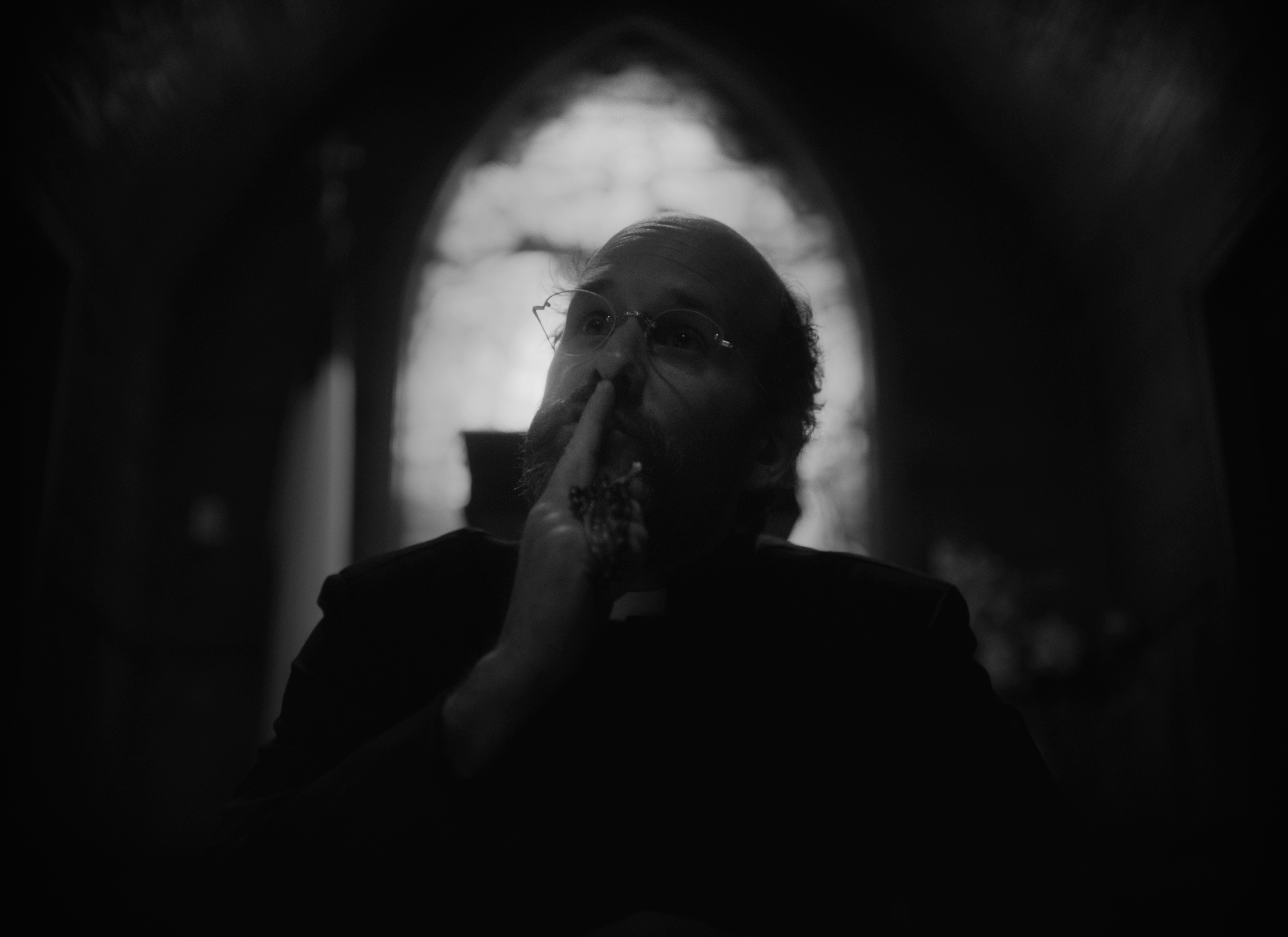
On the eighth day, God went away. This is what the priest (Al Warren) tells his son (Luke Speakman), before strapping on a gas mask and leaving their home. “God left us,” the father says, because Man didn’t respect God. This is why the son can’t go outside. It isn’t safe out there. Or so he’s told.
Except for the fact that the father’s gas mask serves no purpose outdoors. The first thing he does when he leaves the house is take the mask off. Later, he puts on a fake air raid siren so his son believes something dangerous is going on outside, where he can’t see.
If this was the only unusual thing about Godhead, that would be enough for a film (a sort-of riff on Dogtooth). But if this unusual thing is true, then…
Enter two siblings (Sarah Coffey and Kimball Farley) to the church. They aren’t there for prayer or for communion. They are there to ask for judgment; the judgment of the priest. The siblings believe that one of them is akin to God. The Holy Spirit, to be precise. To know for sure, they must be judged with a bullet. If the one who is shot is truly the Holy Spirit, they will ascend up to heaven to take their rightful place as a God.
From this premise, it is clear that this film is a thought experiment wrapped up in a chamber play. The majority of the film takes place at the church, with these three characters cycling through the logical and philosophical puzzles inherent in this trial. Why don’t the siblings simply shoot each other? How could a priest carry out such a cardinal sin? What if one of the siblings is deceiving the other? If a different deity is walking among the human race, then what is God?
Al Warren was the centerpiece of one of my favorite online comedy sketches of recent memory (itself a parody of this gem of a video). He shines here as the stoic but perturbed (and disturbed) priest. He is particularly good at being terse while instructing with a wavering sense of authority. This is how he must act through much of this film, where his character feigns assertive as he loses his control over the situation. The performances of Coffey and Farley are also good, but for different reasons. They are stilted, and occasionally the delivery of their lines come off unnatural. This is intentional, as they are characters believing themselves to be transcendent of the human race. It is endlessly fascinating to watch the three characters interact in different scenarios.
As it progresses, Godhead grows more transgressive. The script builds atop its thought experiment to reveal the darker realities of its characters. Some material worthy of content warnings abound. More notably, the flashback sequences that come out of these darker themes are visually compelling. Harsher lighting and wide lenses produce a disquieting look befitting what we are witnessing. In fact, most of what happens outside of the church has this queasy, extreme wide angle distortion to it that makes the natural world come off unnatural. Mark H. Rapaport gives almost every shot something of visual interest.
Godhead rarely has a dull moment. In the end, Rapaport leaves much of the religiosity of the plot vague and abstract, and the final act leaves much of what we see open to interpretation. There is something sticky to the film’s final scene, though, which grounds these seemingly miraculous events into a realist context. Ending at the rote ritual of a rural church service and the pronouncement of the Trinity is curious. It is provocative without being bombastic. It is open-ended while also having finality. It lingers.
Godhead: B+
As always, thanks for reading!
—Alex Brannan (Letterboxd)

