
The Seoul Guardians is screening as part of the 2026 Fantasia International Film Festival.
The Seoul Guardians follows journalists who, on the ground and in real time, documented the events following the imposition of martial law in South Korea by President Yoon Suk Yeol. The viewer is dropped into the urgency of the situation. Within minutes of the announcement, the journalists are scrambling for cameras and leaving for the National Assembly, where lawmakers are required to go and vote on whether to uphold the President’s action. When the journalists arrive, a protest has already formed outside, and it will only grow as the film continues. It is demonstrated to the viewer, without the need for didactic narration, that the country responded with immediacy to the situation.
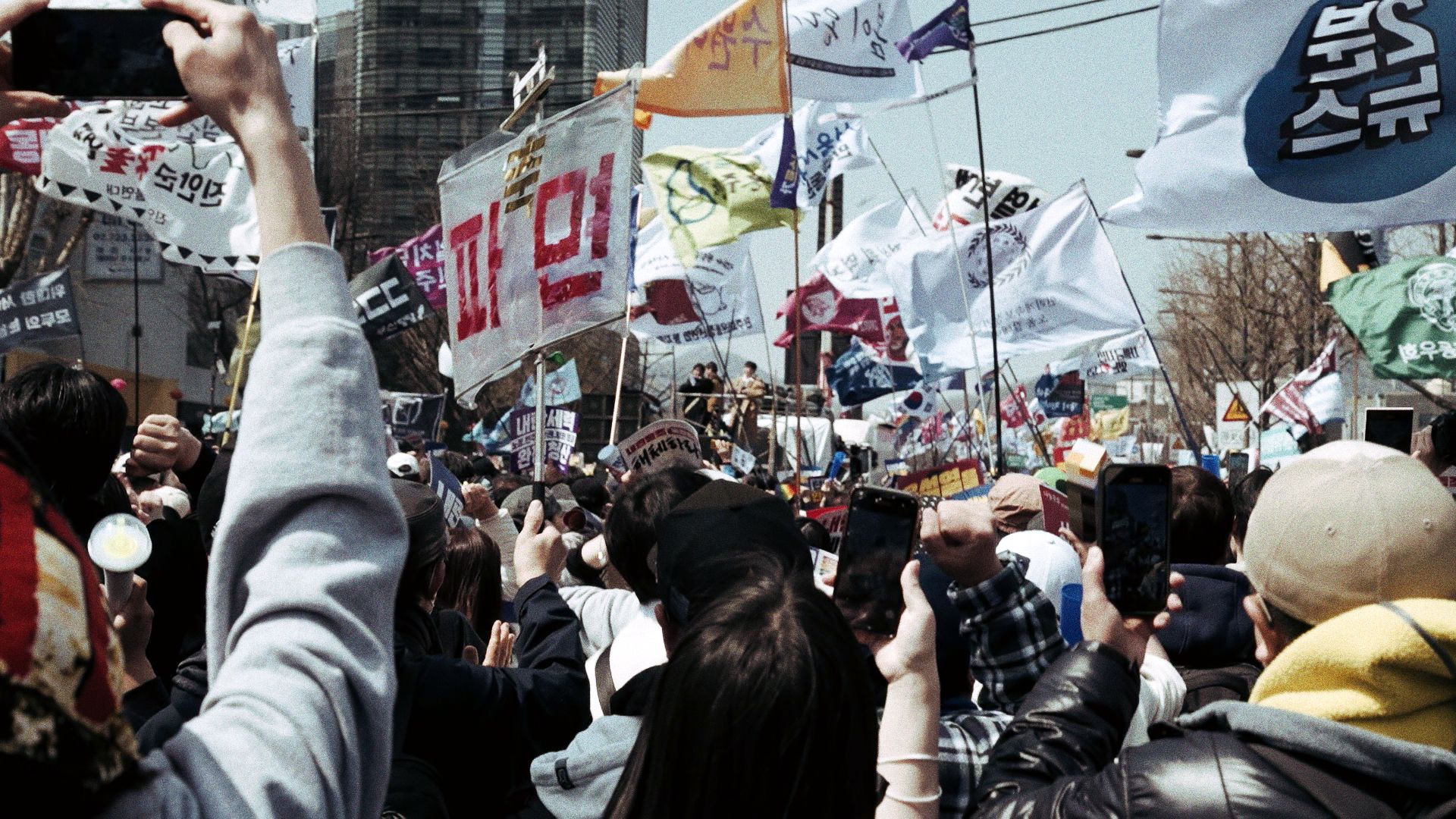
What the film does make clear through didactic narration is the illegal nature of Yoon Suk Yeol’s attempted coup. Lawmakers are meant to assemble and vote on the martial law order. Outside of the National Assembly, however, we see armed military and police actively stopping lawmakers from entering. Some are initially allowed through after showing their identification, but others have to scale the wall to get inside. In the end, only 190 lawmakers of the 300-person electorate made it into the chamber to vote; all 190 voted to lift martial law.
Visual comparisons are made to the 1980 Gwanju massacre. This is the main rhetorical device of the film, and some of the graphic matches are more compelling than others. The most damning comparison comes in the detailing of rules guiding the martial law. Both instances share direct and explicit language restricting or prohibiting dissent and the freedoms of assembly and speech, as well as the attempt by the military to prevent lawmakers from reversing the president’s declaration.
Obviously, the visual parallels don’t need to be perfect for the two historical moments to resonate side-by-side. The blood of a country’s history runs forever. The people we watch in the documentary are keenly aware of this. The 1980 massacre is evidently on the minds of the people involved in resisting the 2024 martial law. As civilians physically ward off armed soldiers on the steps of the National Assembly, one woman pleads with the men pointing guns in her face: “remember the Gwanju massacre.” The ominous lack of autonomy on the part of most of the military personnel is equally chilling, in that these people acting as automatons of the state is a necessary step in the formation and reinforcement of fascist dictatorship. At one point a soldier says the words “I’m just following orders,” which are horrifying to anyone familiar with Nuremberg. A protester pleads with a group of soldiers, “you’re citizens, too,” to which none of them respond.
It isn’t difficult to summarize the value of The Seoul Guardians. While not the only footage captured on that night—we see press camera operators falling over one another to get close-up shots of soldiers trying to break through makeshift barricades to stop the vote—the linear chronicling of events through images is a useful contextualization for an international audience. Beyond the film, close-up documenting of events like these is crucial for the historical record (this should go without saying, but there are no universal truths anymore). The footage that came from this 24-hour period in Seoul is vital to the continuance of Democracy globally. Taken at its most hopeful, the footage produces a blueprint for resisting state violence. It is a document of the fragility and failures of suppressive fascism and the resilience of the suppressed in the face of such violence. It is a reminder that people, not their representatives, make up a Democracy.
The Seoul Guardians: B
As always, thanks for reading!
—Alex Brannan (Letterboxd)
 CineFiles Movie Reviews