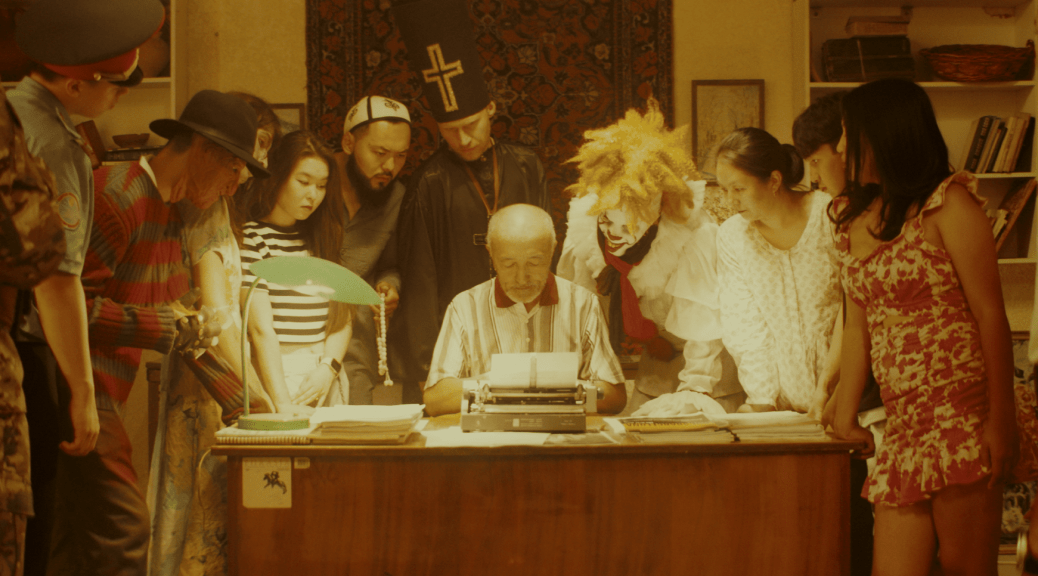
Backstage Madness is screening as part of the 2026 Fantasia International Film Festival
Backstage Madness, a film from Kyrgyzstan from director Amanbek Azhymat, opens with a frenetic, violent sequence fueled by its central character’s inner rage. The character in question, an unnamed screenwriter (Bolot Tileberdiev) typing away at his office typewriter, first appears to be writing a script commissioned by an overtly creepy young man looking to live out his fantasies of non-consensual sex on-screen. The screenwriter loses his cool with the festering creep when the young man starts describing his real-life sex crimes. The scene shifts in tone at least three times as the humor sours into a disgust which begets on-screen violence (which, frankly, evoked some confusion in this dear viewer). It is evident that this all takes place in the imagination of the writer, who culminates the sequence gunning down a crowd of angry people (in his mind, of course).
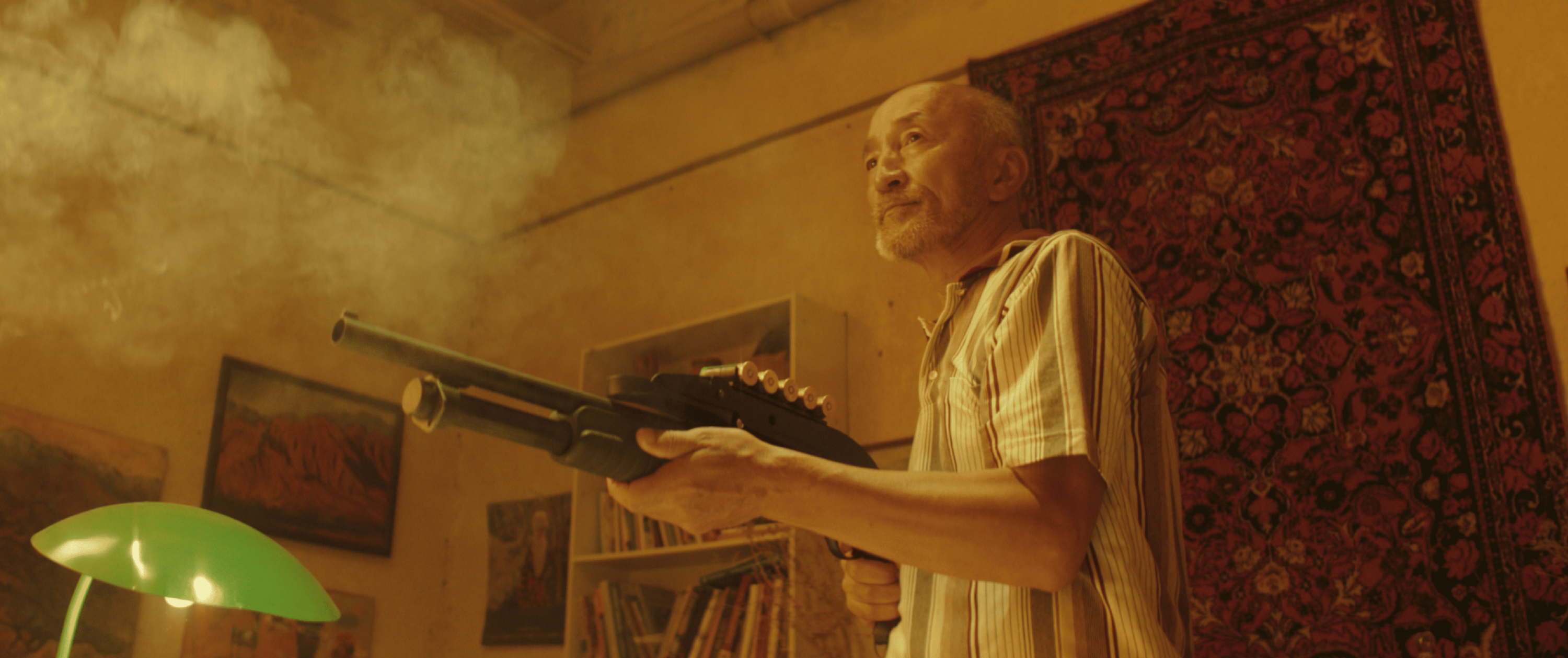
There is perhaps a meta-textual commentary to this opening sequence, given that the plot immediately turns to focus on the writer attempting to get financing for his next project. The only way he can get the film made if it is an action-thriller blockbuster with steamy erotic elements—something far afield from the type of aesthetics-minded films he wants to make. The opening barrage of anger and violence is perhaps simply a reflection of this Hollywoodized approach, something which the writer later explicitly denounces: “ Blockbusters burn bright – but fade fast and are soon forgotten.”
The film progresses toward the realization of the writer’s goal to operate within the bounds of blockbuster filmmaking without being forgotten. What we see is the fruits of the writer’s labor—a film within the film that depicts his ideas as they take shape. The frame story situates this film-within-the-film so that it can be viewed as intentionally over-produced and heavily reliant on action movie tropes. The fictional script is a mess of impromptu action sequences and one-dimensional characters moving through storytelling cliches. If the screenwriter wanted to transcend the formulaic nature of blockbuster cinema, he appears to have failed in that task. The least conventional thing the (real) film has to offer is the bloody opening sequence, which again is more tonally confused than it is effective.
For what it’s worth, the action is all shot very well. Amanbek Azhymat is more than capable of stringing together a visually dynamic set piece. There are a few too many snap zooms for my personal liking, though, which doesn’t help the inevitable comparisons to Quentin Tarantino. Tarantino has been ripped off so much in the last 30 years that it almost feels like a cliché in and of itself to call a movie inspired by Tarantino films. But this one certainly is working hard to emulate the aesthetic (which is itself an aesthetic cobbled together from decades of cinema). So while this all looks good, none of it feels particularly fresh. This is an issue in particular when the narrative is also derivative.
The narrative is generally derivative of crime action cinema, but it also directly cribs from Tarantino in blatant ways. A man is forced into a trunk by criminals who look down at him in a low-angle shot (Reservoir Dogs). A character is unwittingly wrapped up in underground BDSM activities (Pulp Fiction). Two henchmen wearing suits steal a mysterious briefcase whose glowing contents are unknown but which might contain the meaning to life itself (Pulp Fiction). Two enslaved men bare-knuckle fight for the amusement of wealthy patrons (Django Unchained).
In the end, the framing device serves to try and excuse that the story being told has been told before, almost down to the individual shots. The frame story adds a layer, but it doesn’t add much depth. To the extent one could commend it, it adds humor, but even this doesn’t feel particularly inspired. What it certainly adds is length. The film is a desperate sprint toward 80 minutes, and it doesn’t have enough story to adequately fill even this brief window.
One thing I can credit Backstage Madness for is producing a killer soundtrack. The film’s score is a full soundscape of anthemic vocalizations, buzzy hard rock chords, and propulsive percussion. Quite simply, it kicks ass.
Backstage Madness: C
As always, thanks for reading!
—Alex Brannan (Letterboxd)

